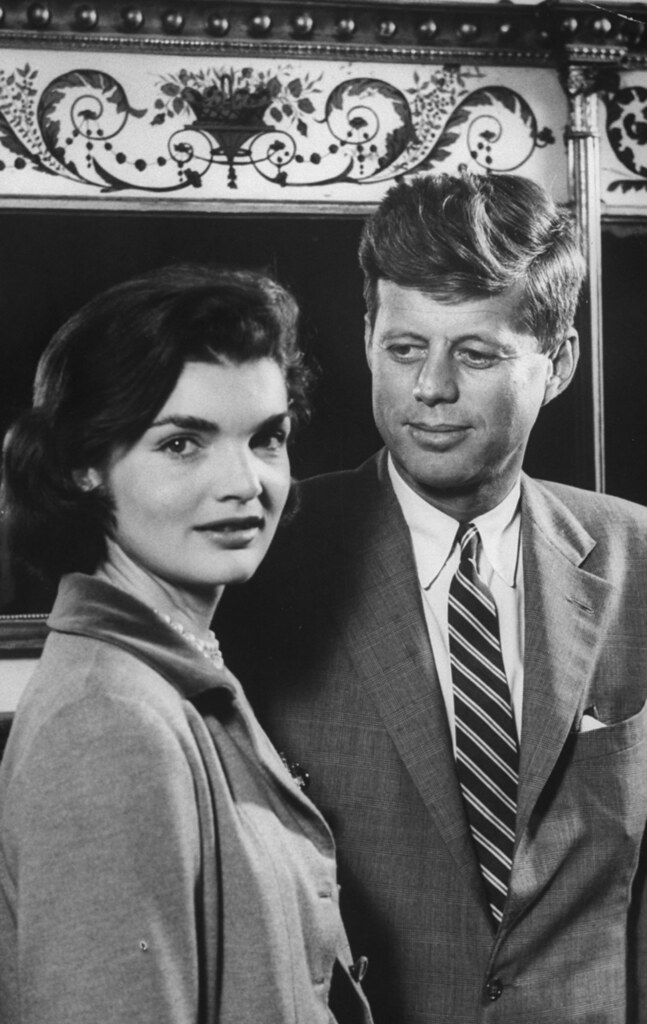
In the non fiction book Killing Kennedy (written by Bill O’Reilly and Martin Dugard about the assassination of JFK) it explains President Kennedy’s faithfulness to his country, but his faithlessness to his wife. This is first explained on page 37 in the quote “which is not to say that John Kennedy limits his sexual relations to the First Lady. While happily married, he is far from monogamous.” On page 82 the Kennedy Monroe affair has been mentioned “The president is entranced by her wit and intellect and would be thrilled to add such a famous sex symbol to his list of conquests.” Page 82 also states when Kennedy invited Monroe to Palm Springs he said, “Jackie won’t be there.”
Although Kennedy had been unfaithful to his wife, he remained faithful to his country. A quote from page 24 explains Kennedy’s faithfulness to the military, “Kennedy, a member of the swim team at Harvard, tows a badly burned crew member by placing a strap from the man’s between his own teeth and pulling him.” Page 86 explains his dedication to the democratic party. “rally that raises more then $1 million for the democratic party.” Finally on page 111 Kennedy’s dedication to his country is shown. “Whatever happens next has nothing to do with being a democrat or republican, and everything to do with what is best for the American people.”
Although JFK made mistakes in his family and marital life, he was still a devoted president to America and the American people.
“Man, how ignorant art thou in thy pride and wisdom! Cease; you know not what it is you say.” -Frankenstein (Pg.204)
That's right. I'm talking about Mary Shelley's Frankenstein. Mary Shelley wrote Frankenstein in 1816. Mary was nineteen at the time recently married to Percy Shelley. They took a trip to Switzerland and became neighbors to Lord Byron. It was a rainy summer and they were often confined to the house and as Mary Shelley put in the introduction of the book “Some volumes of ghost stories, translated from the German into French, fell into our hands.”(Pg.45) And as a group of authors, Lord Byron proposed that they each write their own. There were four of them in this contest of sorts: There was John Polidori Byron's physician friend, Lord Byron, Percy Shelley, and Mary Shelley. Everyone thought of one except for Mary. Then one night, half asleep it came to her. She imagined the creation of Frankenstein's monster. She woke up and wrote the whole story in one night. Pretty amazing huh?
I really enjoyed the story and I think that it's under appreciated. I think it's horror as it should be. Not full of senseless death and maiming, with over use of gore. It's classier than that. It's full of feeling and emotion with twists and turns. It's a tragedy along with a horror story.
I also think Mary Shelley's Frankenstein is also badly portrayed in film. Frankenstein's monster isn't some green guy with bolts in his neck. He's sewn together flesh. He's a thing with emotions, not some bumbling giant. He's vengeful! He's alone! He grieves. I think the book was really powerfully written and impressive. I think everyone should read it.
“Though this be madness, yet there is method in 't – Hamlet. Act 2, scene 2.
Throughout Hamlet, many characters question if Hamlet is going insane. The suspicion of Hamlet's insanity starts in act 2 scene 1, when Ophelia talk to her father Polonius, describing what a scare Hamlet gave her, when he ran into her room, pale and messy-looking “And with a look so piteous in purport/As if he had been loosed out of hell”(act 2 scene 1, line 82-83). She describes. Polonius, being a concerned father to a teenage girl, comes up with a very plausible conclusion: “Mad for thy love?”( act 2 scene 1, line 85), he questions Ophelia. As readers, we know this to be incorrect. Hamlet just saw a ghost, he's probably not going to worried about his romantic troubles with Ophelia. Polonius, of course, doesn't know this and decides to bring this to the attention of Claudius, the king.
In act 2 scene 2, Claudius, the king and Hamlet's “father-uncle” has been informed of the matter, and thinks that Hamlet's “madness” is being caused from his father's recent death. So Claudius sends for Hamlet's two old friends, Guildenstern and Rosencrantz to try and cheer Hamlet up. After they leave, Polonius comes to Claudius and states his theory about Hamlet's insanity: he tells Claudius that he told Ophelia to dump Hamlet because she was out of his league, “Lord Hamlet is a prince out thy star/ This must not be”(act 2 scene 2, line 142-143) and that's why he thinks Hamlet is depressed and therefore acting mad.
So in order to test this theory, Claudius and Polonius arrange a “chance” meeting between Ophelia and Hamlet. And of course, their theory proves to be incorrect. Hamlet approaches Ophelia, telling her that he didn't love her and hypocritically blames her for being promiscuous. After Hamlet leaves Ophelia, Claudius comes to the conclusion that “Love? His affections do not that way tend.../There's something in his soul/O'er which his melancholy sits on brood” (act 3 scene 1, line 162 and 164-165). Polonius disagrees, and still sticks to what he thought before.
Throughout Hamlet, Hamlet seems to get more and more insane. At first we see that he is dealing with the grief and frustration of losing his father and having his mother have that relationship with his uncle. “He was a man. Take him for all in all./I shall not look upon his like again”(act 1 scene 2, line 186-187). But after Hamlet sees his father's ghost, he starts becoming paranoid and progressively insane. When Hamlet puts on the play for his father-uncle Claudius, you can see just how out of it he really is. He insults his mother, and then pretends that everything is jolly and great when his play is shut down, after Claudius leaves in fear and probably anger. Also when he goes to his mother's bedroom and coerces her to face her wrongdoings.“Come, come and sit you down. You shall not/ budge./You go not till I set you up a glass/Where you may see the inmost part of you” (act 3 scene 4, line 18-21). Of course, the argument could be made that Hamlet's insanity is feigned, due to the fact that he tells his mother in the same scene, that he is “...essentially am not in madness/But mad in craft” (act 3 scene 4, line 187-188). What is the correct opinion? You decide.
Sup bors, its Jestr again.I have a huge obsession with the type of electronica music known as
Dubstep.My top five Dubstep producers:
1) Excision
2) Datsik
3) Vexare
4) Downlink
5) The Widdler
To me to me Dubstep is literature. Just like books give you feelings, this music gives you different feelings, and can be analyzed and close read just like books.
First off lets go on a little
background history of Dubstep… It originated in London, England.Dubstep is based on some different genres of
music: Reggae, Rave, grime, 2-step, drum and bass, and breakstep.
The first major record companies were also
based in England: Big Apple, Tempa, and Ammunition.Dubstep was created in the late 1980’s and
the early 1990’s.
Right now there are thousands of deejays out there in the
world, but we’re going to focus on one in particular: Vexare.
Listen to "Still Remaining" below:
What makes
Vexare so unique is the fact that he plays with the MIDI Keyboard a lot in his
songs.MIDI Keyboards screwed up music
back in the day but people are content with where the MIDI is now.It’s with all Electro types of music.
Here’s a MIDI Keyboard:
Anyways, Vexare always messes with
our minds with the soothing tones of his MIDI-started songs.Still Remaining for instance, is one of his most
intense bass drops.Still Remaining in the
beginning is a very soothing until 28 minutes in the song when the synthesizer
samples start playing.The samples are
obviously bitcrushed with about 7bits maybe 8.
Bitcrushers
damage bits in songs so that it makes the bits sound kind of staticy.
When the bass
drum beat ‘builds’ up to the bass drop that’s when we assume that the ‘drop’ is
going to be intense.
Finally,
when the bass drops Vexare used his really professional dee jaying skills to
make wobble bass and subby bass as he’s stepping (dubstepping.)
I’ll show
you a pictures of wobble bass on the Fruity Loops Dubstep Software.
Also, what’s unique about Vexare’s songs is the different pitches
and beats that he uses.For instance in
the Clockmaker, he keeps on switching to one pitch to another, very quickly.
Back to
Still Remaining, Vexare has unique sounds he makes; I can’t really explain them but
if you want you can listen.
The real reason
I like Still Remaining is because it has a lot of subby and wobble bass. It also is very, very intense because: it has
intense beats and a fast pace.
The
different kinds of drum samples in this song are obviously unique to
Vexare.If you want to make Dubstep by
yourself you need to not have a drumkit. You use drumkit samples. J
Anyways,
about the beat in Still Remaining…
When I
listen to it I hear: snare, hihat, cymbals, and bass drum.The bass drum, I hear, is mostly in the build
up to the drop.
When the
bass drops, mostly snare and cymbal samples are audible.
About the
dubstep parts, Vexare also uses the turntables to make the sound more, um,
wobbly? J
Anyways, in
the Dubstep parts Vexare switches the dials to switch pitches a lot to make
more ‘intense’ sounds.
After the
first bass drop, Vexare uses synth samples and MIDI to go back to that awkward
soothing/relaxing piano part.
After 30
more seconds: the bitcrushed synth comes back a second time.This time it sounds like there is two of the
same synths (but at different pitches) at the same time.
When it
gets to the bass drop again, the synth and the Dubstep are going at the same
time.Its common in many, um lets say,
Skrillex songs to have two different drops, but they have different delay,
attack, and decay in them.
Delay,
attack, and decay all make the dubsteppy stuff sound good.
So when you
have the chance, listen to Still Remaining by Vexare.
So bors,
next time let’s dubstep it up another level, next time: Swagga by Excision and
Datsik.
Key terms: Bitcrushers, wobble bass (wobbs,) subsonic bass (subby,) MIDI, synthesizers, hi hat, snare, kick, bassline, bass, bass drops, cymbal, delay, reverb, decay, and attack.
Cooked is a book that talks about the science and culture that
surrounds food. It is written by Michael Pollan, who is the author of The
Omnivore’s Dilemma. The book takes you on a journey with the 4 elements that
prepare food (fire water, air and earth) alongwith sharing his opinions of what it means to cook. In fire, he goes on
a journey looking at barbeque. He starts in the south and ends up in the Basque
region of Spain at a restaurant that smoke infuses all their food. At the
beginning, they eat smoke infused butter and finish off with smoke infused
cream. Smoke changes the molecular structure of foods. If you are familiar with
restaurants like El Bulli which make basil foam and salad Jello(molecular
gastronomy)barbeque wouldn't compare.
After reading how it
chemically changes the meat though, it very well could fall into that cuisine.
To jump ahead, Water is about the essence of boiling and
braising.
Braise
It focuses a lot on onions and how they are the most important
part of every stew.
Air is about baking, this is where the author talks a lot about
how wonder bread isn’t REAL bread. He meets with more experts on food. He talks
with a baker about the perfect bread.
Earth is about fermenting. I learned a lot from this. Apparently
people use all sorts of sauerkrauts and kimchis as home remedies, but Kombucha
(my favorite drink)
has supposedly been used
to cure diabetes. Archaeologists found a breadfruit pile fermenting for 200+
years and it was still edible. I wouldn’t want to eat it. Towards the end he
gets into the most commonly ingested kind of fermented item: alcohol. He discusses
why humans and other animals like flies and bats drink it, even though it seems
like an evolutionary disadvantage to be intoxicated.
Apparently in wild animal culture it helps with finding a mate
and producing offspring (survival of the fittest). Who knew? Along with that it
helps with survival because it is produced naturally in bruised fruits and if
animals are willing to eat the yucky fruits they won’t die of starvation. That
means humans don’t need it because we have mass produced food and drink! Thank
you evolution!
Authors are starting
to create more kickbutt female characters in their books. Why? Well I think
there are alot of reasons why. One is because we need kick butt females characters in our books for teenage girls. And the reason why is because the female celebrities in our world are teaching young girls to be helpless to act stupid
to let boys use them to their advantage. And the woman in our society think that
is the right answer but IT IS NOT THE RIGHT ANSWER AT ALL.
Women in general
are better then that. They deserve to be treating with respect they deserve to
be equal to men. And some women in our society are realizing that and that’s
why authors are making the main characters in books as kick butt females. And the
teenage girls who read these kinds ofbooks
are more likely to become that type of woman in those heroine books.
Anyways one book
example for a heroine book is the Hunger Games Trilogy. The Hunger Games Trilogy’s main character is a
sixteen year old kick butt female called
Katniss Everdeen.
Katniss Everdeen volunteers
to take her younger sisters place Primrose Everdeen in the Annual “hunger
games.“
What if Katniss
didn’t take the place ofPrimrose Everdeen
in the Annual Hunger Games? Then the story wouldn’t be about Katniss Everdeen
it would be about her little sister Primrose Everdeen. The Author put that
event in the story so Katniss can be the main character. That’s how the Author
made the story about Katniss Everdeen by Katniss taking her younger sister’s
place in the Annual hunger games.
And that is the
beginning of how Katniss started to become her heroine self. Through the call to
adventure, taking her sister’s place in the Annual Hunger Games. Through all of
the Hunger Games Trilogy she is very brave and courageous. At the end of the
book one Katniss is one of the last survivors among the teenagers in the Hunger
Games. Katniss is the definition of a heroine book character.
In talking about close
reading, we have thoroughly talked about writing and “voice”, the unique style
that a writer can have. A truly competent writer has a grasp on precision of
language; he can manipulate words at his disposal to make a reader feel a certain
way. This is the work of an artist. In class, we talked about how much a writer
can convey to a reader simply through the length of his sentences. There is a
certain flow that an effective writer can bring to a paragraph. Writing is like
its own language that can be interpreted and analyzed in countless ways. The same is true of film.
We can apply close reading to movies as much as we can to writing. In class, we
watched the iconic crop duster scene from Hitchcock’s film North by Northwest. We saw how much could be conveyed with just
simply the length of each shot. In this scene, the cuts between the shots
happen faster and faster as the climax approaches. As these cuts happen, the
tension in the audience is built up; its effect is that it makes our hearts
race increasingly as the speed of the cuts gets faster. This is just one
example of close reading a scene in film.
The films of any great
director are packed with different forms of cinematography and editing that
conveys different feelings. Many times, the average audience overlooks these
complexities in film. This is evident when I watch a film with a
non-cinemaphile friend, and ask them what they liked or disliked about it.
Usually, the answer is centered around the story and plot of the film we just
watched, rather than what makes it viscerally or visually interesting. Usually,
after a discussion of story and plot with this non-cinemaphile friend, I’ll ask
them, “So what did you think about the film’s cinematography?” The answer I get
is almost always, “Oh, I don’t pay attention to that.”
I think this is an
interesting phenomenon. Many people who watch a film and enjoy it will not be
able to explain what it is that made it effective as a film. This is the same
thing as people who don’t have a taste for the use of language in writing.
Close reading in these two forms of media, in this sense, is very similar.
This is what close reading
is really all about. It is about analyzing texts and being a smart reader. This exact same idea can be applied perfectly
to cinema, just as much so as to reading. This is important because the
authenticity of film as an art form has always been questioned; it is often thought
of as a lesser form of art than other, more “sophisticated” mediums. A closer
reading shows that film can be as sophisticated as English literature. The crop
duster scene in North by Northwest is
only a very small example of what film does with audiences.
I guess the goal with
writing about close reading for me is to open up a world of reading to the
uninitiated that they’ve never seen before. As one who highly values film and
cinematography, I see the potential in close reading film. The general public
can watch movies so much more differently than they do right now.